I wanted to talk about how I use art in my Social and Language arts as well as art. I have included a few artists that you can refer to. To integrate my curriculum, one of the things I do is take a few Indigenous artists from this region or Western Canada. We talk about the style but also the emotions that are portrayed through medium and message. Then the students write to the artist to express how the art made them feel. This brings in the Language Arts component. We also read biographies of these artists. This year, we will be looking at the art of Alex Janvier. He is a friend of my husband's family. We will explore his art, examples of...like the new Stadium in Edmonton, the Art Gallery of Canada as well as his introduction to art at Blue Quills residential school. When we are done the unit they will be writing to the artists. We have not yet received a response but perhaps this year. Below are some subject areas that may inspire you!
Monday, 26 November 2018
Grade 5 Best Practices - Integrating Social, Art and Writing Through Culture
TQS - 5. A teacher develops and applies foundational knowledge about First Nations, Métis and Inuit for the benefit of all students.
c) using the programs of study to provide opportunities for all students to develop a knowledge and understanding of, and respect for, the histories, cultures, languages, contributions, perspectives, experiences and contemporary contexts of First Nations, Métis and Inuit
3. A teacher applies a current and comprehensive repertoire of effective planning, instruction, and assessment practices to meet the learning needs of every student.
a. incorporate a range of instructional strategies, including the appropriate use(s) of digital technology, according to the context, content, desired outcomes and the learning needs of students
Using the upcoming TQS, I wanted to address the standards above and how I have and will continue to implement them in my daily practice.
This new school year has been a very big transition for all of us. Between the physical moving into a new physical space and the pedagogical moving of implementing a schoolwide Guided Reading program, I know that I have felt very overwhelmed and wonder how I will “cover it all” when it comes to the curriculum.
One of the ways that I have found that helps me cover our very broad curriculum is integration. I love to find connections not only between subject areas but also finding themes that I can use to weave the curriculum together. My students find a lot more meaning and they are more engaged when I have interdisciplinary projects.
Last year, I was able to fulfill a project that I had thought of many years ago. Grade 5 Social Studies is a very dense curriculum. We study the history of Canada from Pre-Colonialism all the way through to Confederation, to the influence of the Famous Five and NWMP to the influence of geography of the Canadian Regions on where and how people live and we also cover Indigenous groups across Canada and their impact on our history and culture.
It’s a lot of curriculum. And it can be very dry.
Last year, for Canadian Regions topic, I decided to integrate art into the lessons. We studied the geography, the resources and the people. We also looked at the Group of Seven and the artwork they created that is so representative of Canadian geography. Students were assigned a region and they had to find an image that represented their region. We created multiple rough drafts on paper. I gave constant feedback for improvement as they worked. Eventually, students moved to fabric markers and fabric squares that they used to depict their final pieces of art. Once those were completed, my mother (who is a wonderful seamstress) took the fabric art pieces and created a quilt.
This year, I wanted to teach another idea that I had been thinking of for many years as well. Again, Social and Art became the focus.
Grade 5 Social Topic 2 is titled “Histories and Stories of Ways of Life in Canada”. This topic focuses heavily on the history and culture of Indigenous groups across Canada. Using a research activity from Black Gold Regional Schools, I tweaked the project to have students research five groups across Canada.
Students use the following website http://firstpeoplesofcanada.com/index.html to research the group assigned to them. They collect information about the food, ceremonies and beliefs, tools, shelter, family structure and transportation. The five groups we are collecting research on are the Arctic People, the Northwest Coastal People, the Plains People, the Eastern Woodland Hunters and the Eastern Woodland Farmers. The latter two became the focus for the Art portion of this unit.
Using Norval Morrisseau as an inspiration, we read his biography and studied his paintings which are in the Eastern Woodland Style. These paintings have been called Spirit Paintings and X-Ray Paintings. They are a simple style with vibrant colours but there is purpose to everything within the picture. Circles can represent the heart, the mind, the soul of the animal or creature. Lines trailing from the creatures can represent the spirit.
Taking this understanding of the style, we are currently creating sketches of an animal that we feel connection to. Students will create rough copies until they have taken their art to a level that they are content with. Then we will begin to paint our creations. As we work on this portion of the project, I am also introducing a writing element to the project. Students will create their own origin legend for the creature they are painting.
When we are done this project, students will have crossed three different subject areas and multiple objectives will have been met. Because schedules can be a struggle, I do not feel the need to contain my Art or Writing or Social to a specific block during a week. Basically, my Literacy, Art and Social times are all up for grabs which allows me the time to spend on this project so students can create quality work that is meaningful to them.
The last piece in the puzzle that I need - the bulletin boards to be installed in my room so that we can display our work.

Thursday, 25 October 2018
Ms.McLeod's ECS blog
Jolly Phonics Video
This year I have incorporated the Jolly Phonics program to add actions to learn alphabet sounds.
We review each sound and action every day. The children love it, and seem to be remembering the letter sounds.
Sunday, 21 October 2018
Fostering Effective Relationships
I have spent a lot of time thinking about how to build relationships with my new students since I am changing grades now. I am thankful that I have previously taught some of my new students and/or have a relationship with their families. I need to work harder to continue to grow these relationships and develop new relationships with the students that I do not have a connection with since we are nearing the end of October.
The teaching standard Fostering Effective Relationships I believe will be crucial to the success of this transition.
To help my students, I will be letting them know that they have been selected to be the role models for the red wing and the students in the red wing will be looking up to them as leaders.
The following are the main ideas from the link and a good reminder for all of us to keep our classrooms an environment with high expectations, respect and caring.
1) Communicate high behavioral and academic expectations for all students.
-call on all students equitably
The link reminds us that when we forget to recognize some students, it communicates a low level of confidence in their abilities and they may 'tune out.'
- Increase latency periods when questioning students
- give hints and clues to help students be successful
- be positive and tell students they have the ability to do well
- correct students in a constructive way
The following quote from the article really stood out for me, "Students will recall how you made them feel long after they have forgotten the consequence they earned as a result of their actions."
-developing positive classroom pride
- demonstrating caring
This made me think of the building relationships spreadsheet we are filling out . Knowing their interests outside of school is a great way to show we care about the child as an individual and not just as a student.
-preventing and reducing frustration and stress
Suggestions for staff when we feel overwhelmed.
http://www.ascd.org/publications/books/105124/chapters/Developing_Positive_Teacher-Student_Relations.aspx
The teaching standard Fostering Effective Relationships I believe will be crucial to the success of this transition.
To help my students, I will be letting them know that they have been selected to be the role models for the red wing and the students in the red wing will be looking up to them as leaders.
The following are the main ideas from the link and a good reminder for all of us to keep our classrooms an environment with high expectations, respect and caring.
1) Communicate high behavioral and academic expectations for all students.
-call on all students equitably
The link reminds us that when we forget to recognize some students, it communicates a low level of confidence in their abilities and they may 'tune out.'
- Increase latency periods when questioning students
- give hints and clues to help students be successful
- be positive and tell students they have the ability to do well
- correct students in a constructive way
The following quote from the article really stood out for me, "Students will recall how you made them feel long after they have forgotten the consequence they earned as a result of their actions."
-developing positive classroom pride
- demonstrating caring
This made me think of the building relationships spreadsheet we are filling out . Knowing their interests outside of school is a great way to show we care about the child as an individual and not just as a student.
-preventing and reducing frustration and stress
Suggestions for staff when we feel overwhelmed.
http://www.ascd.org/publications/books/105124/chapters/Developing_Positive_Teacher-Student_Relations.aspx
Monday, 24 September 2018
Setting up Expectations for the Beginning of the Year
Since it is the beginning of the year, and it is a new setting for all of us, it seems natural to talk about expectations and how we all set up our classrooms and expectations for the new school year.
One of the standards I believe addresses how we go about this is this teaching standard:
1 (a) acting consistently with fairness, respect and integrity;
Children from a very early age learn and can be taught what is fair and what is respectful.
As teachers, children often come to us without a full understanding of these ideas, and over time, we try to impart and teach and model these ideals as much as possible.
One of the ways in which we do this all the time is setting up expectations. Expectations for how work is done in the classroom, how to treat friends, classmates and teachers; and how to address someone or ask a question when there are others to consider in the room.
Routines are great for this and start the first day. This year our classroom started with a Sharing circle, what was expected in that circle, and positive interactions are always reinforced. Reminders were given to those that needed it, but the most important thing is to create a sense where everyone gets a chance to say their piece, even if it is just to say "pass" if they did not feel like sharing anything that day.
Another way I try to continue this is using our Classroom Meeting. Every Wednesday at last block, we have our meeting where we can talk about decisions or announcements to make as a class from field trips to new rules or routines. We also open up our Bother box, to see if there has been anything going on during the week that has created problems for a student or other students. Students may anonymously write their issues on a piece of paper and put it into the box. When we read the papers we find out how those issues affect others and come up with a democratic solution about how to deal with them. The students enjoyed our first meeting and it fostered a sense that even though as teachers we can't always see and deal with all problems right away, that they will be listened to and treated with respect. This is also a great modelling behaviour to allow students to see fair ways to deal with problems.
Setting limits and rules is also important of course. This year we have been setting rules and boundaries as they have been modelled, rather than trying to make a list of rules in the first day or few days of school. This has allowed the students a little more opportunity to remember them as the first few days back from school seem like a blur to everyone, including teachers!
We are all human beings and it is good to remind ourselves of that whenever we are dealing with students (and even adults) that make mistakes or make poor choices.
This book is an excellent resource I have implemented in the classroom and recommend it to anyone who hasn't read it and has had to deal with many issues regarding expectations and behaviour in the classroom:
Sunday, 23 September 2018
Dubé 4B’s Best (Developing) Practices – Indigenous Knowledge in the Classroom
Updated TQS: 5C – using the programs of study to provide opportunities for all students to develop a knowledge and understanding of, and respect for, the histories, cultures, languages, contributions, perspectives, experiences and contemporary contexts of First Nations, Métis and Inuit
A little bit about me... I have an Indigenous Studies minor and have participated in two Indigenous field schools. I have been taught by Indigenous professors all across Canada and the United States. This past summer I skipped out on my convocation (oops!) to attend an Indigenous Hawai’i Field School for three weeks with Dr. Renae Watchman (Mount Royal University professor who is a Stanford alumna) and Dr. Robert Innes (University of Saskatchewan professor). The field school focused on Aloha Aina activism. Two summers ago, I participated in a Treaty 7 Field School. The topics covered included: Plains peoples prior to European contact, the events leading to Treaty 7, representation of Indigenous peoples in museums and historic sites, and the impact of Treaty 7 on First Nations in what is now southern Alberta. My favourite part of both of my field schools was connecting with the land and learning from Indigenous peoples in different communities.
I advocated for an Indigenous placement my entire post-secondary experience. My university assigns the school and mentor teacher for each teacher candidate so that there is no bias in our evaluations. There are multiple students at one school to create a cohort for weekly seminars. I finally had the placement I had been hoping for on Tsuut'ina First Nation for my last practicum. My cohort was the very first one to ever be placed on Tsuut'ina. :) Prior to my final practicum, I had two school placements in Calgary Board of Education schools (Glamorgan and Sunalta, respectively). My third-year practicum was also in a Calgary Board of Education school (Woodbine). These are all predominantly white communities in the southwest side of Calgary. I taught my Grade 3 students at Woodbine how Peruvian people weave in my third-year practicum, and then I also taught them how to Métis finger weave. This was the only opportunity that I was able to include some Indigenous knowledge before my final practicum, and that is why my practicum at Chiila Elementary School was so important to me. I am constantly trying to find ways to bring Indigenous knowledge and learning into my teaching practice. This is a lot more exciting now that I have my own classroom!
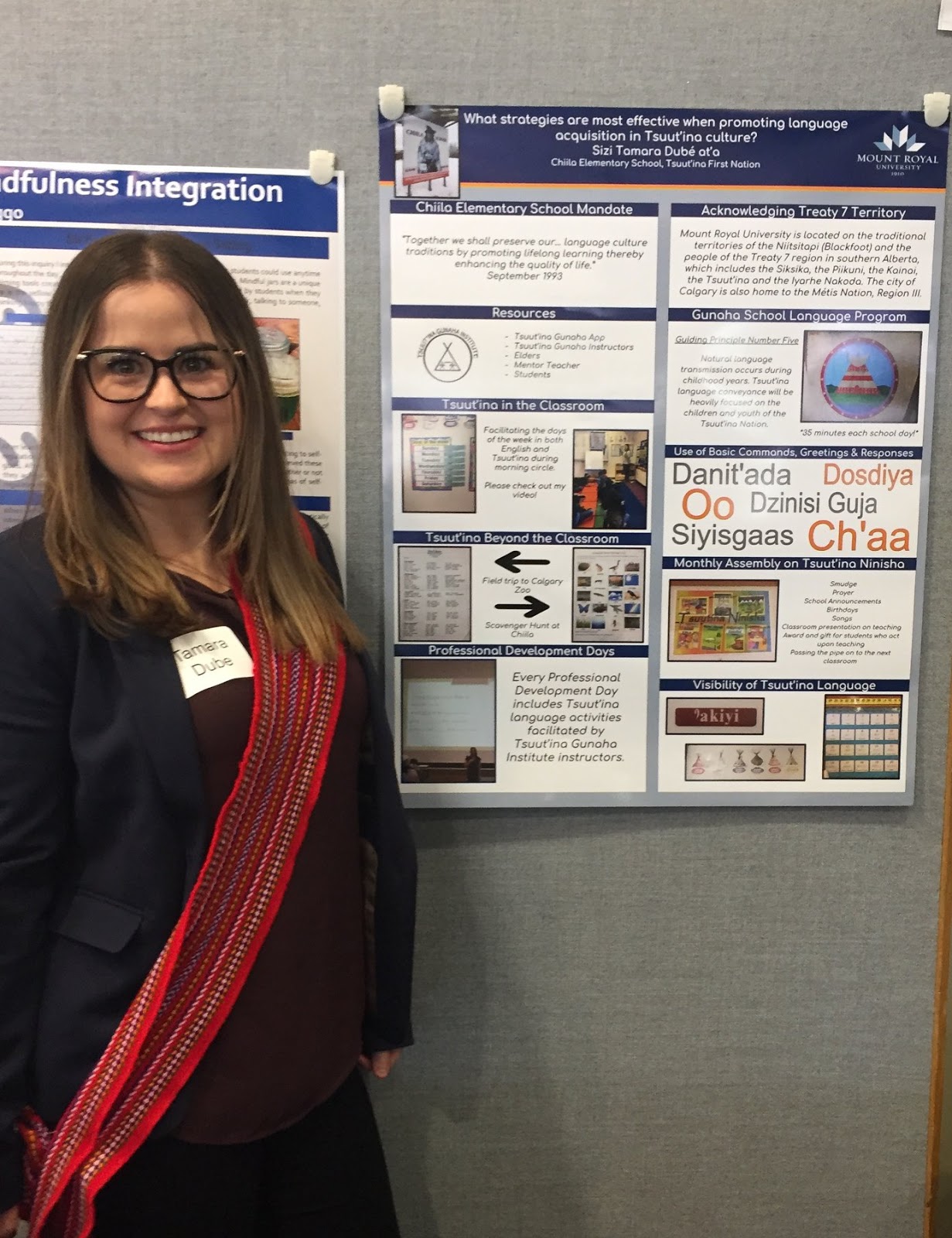
For our final practicum, my faculty hosts a capstone event where teacher candidates are required to research an area of curriculum or professional development in the form of an inquiry. For my capstone project, I really wanted to be vulnerable and study an area that I had little knowledge with… Indigenous languages! My practicum was four months long, so I had plenty of time to learn while teaching. A majority of the staff at Chiila Elementary School are non-Indigenous or from a different First Nation. I wanted to see what it would feel like to be able to use the language that my students practiced for 35 minutes every day in Tsuut'ina Gunaha (their cultural language class) in their homeroom as well.
My inquiry question was “What strategies are most effective when promoting language acquisition in Tsuut’ina culture?”
Here is a picture of me with my poster…
The video below is of me facilitating our morning calendar in Tsuut’ina. I would use Tsuut’ina for greetings (hello, good day, good bye, how are you?, etc.), basic commands (eyes of me, come here, stand up, sit down, line up, yes, no, etc.), good job, thank you, days of the week, and counting. I also learned a handful of the animal names, months of year, and colours. This helped me become a better educator in the classroom because I was fostering my students’ identity. I was creating a bridge between what they were learning in the cultural room to the homeroom classroom. They were not two separate learning experiences (the Indigenous and the Western), but one that was interconnected.
In Grade 2, students study Saskatoon, Iqaluit, and Meteghan. I was responsible for Saskatoon, but did teach a little bit of the other two communities as well. I decided to include Indigenous languages with each of our communities. I am fortunate enough to have relationships with educators who are Cree, Mi’kmaq, and Inuit that helped me teach my students a couple basic words in their native tongue. My students really enjoyed this experience. A lot of Indigenous languages are near extinction, and they loved knowing that they were protecting other First Nations languages from extinction by knowing a couple of words. They also loved knowing that there were students out there who were learning their ancestors’ language as well. This exposure has inspired me to continue to learn ways that I can integrate Indigenous languages in my classroom.
I have only been teaching as a certified teacher for two weeks. I have so many wonderful ideas for my Grade 4’s this school year that I would love to share with all of you, but I still need more time in my classroom to implement my plans. This week, my students and I are going to have a conversation about how Indigenous peoples were resourceful after hunting bison. What was each part of the bison used for? How does this connect to the Waste and Our World unit? In Social Studies, I am really excited to have the opportunity to teach about the different regions. I learned on my Treaty 7 Field School that the hoodoos at Writing-On-Stone Provincial Park are sacred to the Blackfoot. I also learned about the importance of the mountain region to the Ĩyãħé Nakoda. I am excited to have Elders from different regions share their voices in my classroom as we study Alberta’s history and land regions. I am constantly looking for ways to embed Indigenous learning into the curriculum. I am teaching puberty for the first time this year and am thinking about bringing in an Elder to explain the sacredness behind moon time and why Indigenous women do not smudge or participate in ceremonies during this time. There is always a meaningfully way tie Indigenous knowledge into the curriculum. I feel blessed for the relationships that I have built while in university and am looking forward to building new ones while teaching here at Ashmont!
I would love to hear some of the ways that you tie in Indigenous knowledge into your classroom! Thank you!
Friday, 27 July 2018
Virtual Math Summit
Now I realize it is the middle of the summer and many people are not even thinking of school. However, I thought I would put this out there. Next week, Christina Tondevold is hosting a virtual math summit, Building Math Minds, with what looks to be an amazing line up of speakers including, Marian Small, Dr. Nicki, etc.
I have been following Christina on her blog and Facebook page (The Recovering Traditionalist) and she is full of practical math ideas.
Anyway, below is the link if you happen to want to tune in.
https://buildmathminds.com/ vms18
I have been following Christina on her blog and Facebook page (The Recovering Traditionalist) and she is full of practical math ideas.
Anyway, below is the link if you happen to want to tune in.
https://buildmathminds.com/
Subscribe to:
Posts (Atom)