Updated TQS: 5C – using the programs of study to provide opportunities for all students to develop a knowledge and understanding of, and respect for, the histories, cultures, languages, contributions, perspectives, experiences and contemporary contexts of First Nations, Métis and Inuit
A little bit about me... I have an Indigenous Studies minor and have participated in two Indigenous field schools. I have been taught by Indigenous professors all across Canada and the United States. This past summer I skipped out on my convocation (oops!) to attend an Indigenous Hawai’i Field School for three weeks with Dr. Renae Watchman (Mount Royal University professor who is a Stanford alumna) and Dr. Robert Innes (University of Saskatchewan professor). The field school focused on Aloha Aina activism. Two summers ago, I participated in a Treaty 7 Field School. The topics covered included: Plains peoples prior to European contact, the events leading to Treaty 7, representation of Indigenous peoples in museums and historic sites, and the impact of Treaty 7 on First Nations in what is now southern Alberta. My favourite part of both of my field schools was connecting with the land and learning from Indigenous peoples in different communities.
I advocated for an Indigenous placement my entire post-secondary experience. My university assigns the school and mentor teacher for each teacher candidate so that there is no bias in our evaluations. There are multiple students at one school to create a cohort for weekly seminars. I finally had the placement I had been hoping for on Tsuut'ina First Nation for my last practicum. My cohort was the very first one to ever be placed on Tsuut'ina. :) Prior to my final practicum, I had two school placements in Calgary Board of Education schools (Glamorgan and Sunalta, respectively). My third-year practicum was also in a Calgary Board of Education school (Woodbine). These are all predominantly white communities in the southwest side of Calgary. I taught my Grade 3 students at Woodbine how Peruvian people weave in my third-year practicum, and then I also taught them how to Métis finger weave. This was the only opportunity that I was able to include some Indigenous knowledge before my final practicum, and that is why my practicum at Chiila Elementary School was so important to me. I am constantly trying to find ways to bring Indigenous knowledge and learning into my teaching practice. This is a lot more exciting now that I have my own classroom!
For our final practicum, my faculty hosts a capstone event where teacher candidates are required to research an area of curriculum or professional development in the form of an inquiry. For my capstone project, I really wanted to be vulnerable and study an area that I had little knowledge with… Indigenous languages! My practicum was four months long, so I had plenty of time to learn while teaching. A majority of the staff at Chiila Elementary School are non-Indigenous or from a different First Nation. I wanted to see what it would feel like to be able to use the language that my students practiced for 35 minutes every day in Tsuut'ina Gunaha (their cultural language class) in their homeroom as well.
My inquiry question was “What strategies are most effective when promoting language acquisition in Tsuut’ina culture?”
Here is a picture of me with my poster…
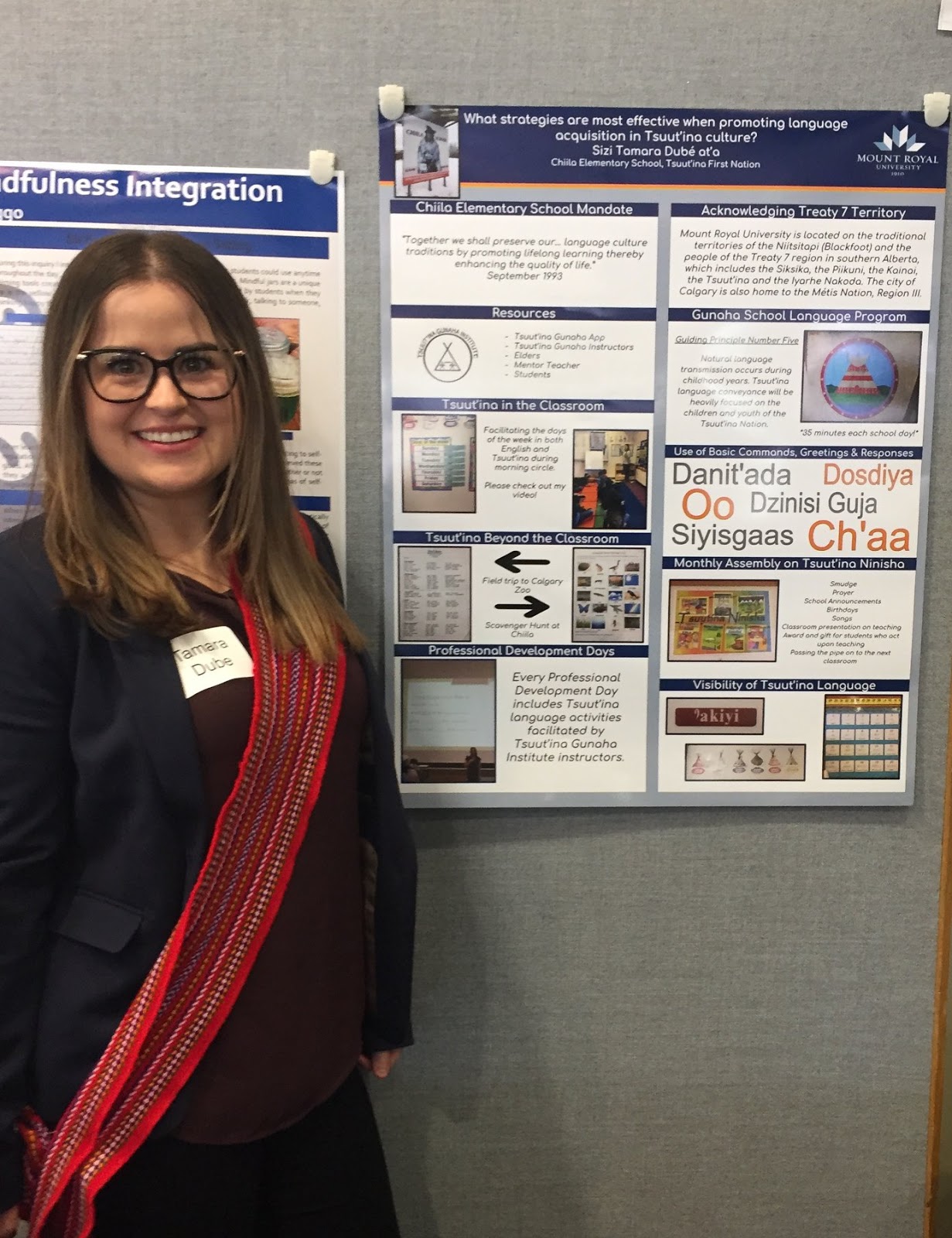
The video below is of me facilitating our morning calendar in Tsuut’ina. I would use Tsuut’ina for greetings (hello, good day, good bye, how are you?, etc.), basic commands (eyes of me, come here, stand up, sit down, line up, yes, no, etc.), good job, thank you, days of the week, and counting. I also learned a handful of the animal names, months of year, and colours. This helped me become a better educator in the classroom because I was fostering my students’ identity. I was creating a bridge between what they were learning in the cultural room to the homeroom classroom. They were not two separate learning experiences (the Indigenous and the Western), but one that was interconnected.
In Grade 2, students study Saskatoon, Iqaluit, and Meteghan. I was responsible for Saskatoon, but did teach a little bit of the other two communities as well. I decided to include Indigenous languages with each of our communities. I am fortunate enough to have relationships with educators who are Cree, Mi’kmaq, and Inuit that helped me teach my students a couple basic words in their native tongue. My students really enjoyed this experience. A lot of Indigenous languages are near extinction, and they loved knowing that they were protecting other First Nations languages from extinction by knowing a couple of words. They also loved knowing that there were students out there who were learning their ancestors’ language as well. This exposure has inspired me to continue to learn ways that I can integrate Indigenous languages in my classroom.
I have only been teaching as a certified teacher for two weeks. I have so many wonderful ideas for my Grade 4’s this school year that I would love to share with all of you, but I still need more time in my classroom to implement my plans. This week, my students and I are going to have a conversation about how Indigenous peoples were resourceful after hunting bison. What was each part of the bison used for? How does this connect to the Waste and Our World unit? In Social Studies, I am really excited to have the opportunity to teach about the different regions. I learned on my Treaty 7 Field School that the hoodoos at Writing-On-Stone Provincial Park are sacred to the Blackfoot. I also learned about the importance of the mountain region to the Ĩyãħé Nakoda. I am excited to have Elders from different regions share their voices in my classroom as we study Alberta’s history and land regions. I am constantly looking for ways to embed Indigenous learning into the curriculum. I am teaching puberty for the first time this year and am thinking about bringing in an Elder to explain the sacredness behind moon time and why Indigenous women do not smudge or participate in ceremonies during this time. There is always a meaningfully way tie Indigenous knowledge into the curriculum. I feel blessed for the relationships that I have built while in university and am looking forward to building new ones while teaching here at Ashmont!
I would love to hear some of the ways that you tie in Indigenous knowledge into your classroom! Thank you!


